September 23, 2026 · Wednesdays
After the Applause — The Pomegranate and the Mask
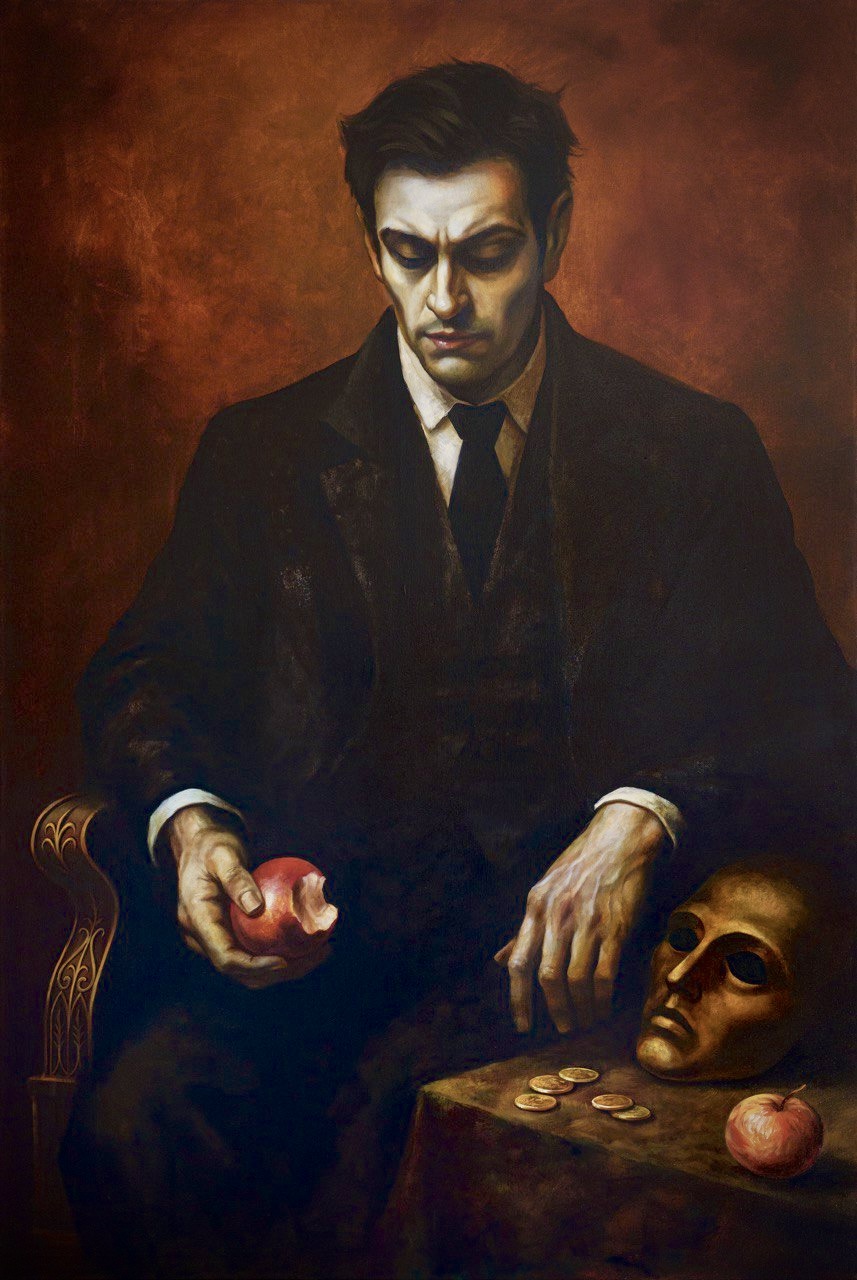
There is a particular weight that settles into a room after a performance ends.
Not the silence itself, but the moment when the public face no longer has to be held.
We rarely speak about the architecture of that face — the quiet agreement between the role we show to the world and the private, breathing body that has to carry it.
In Evgeniy Lapchenko’s The pomegranate, the mask, from the Icon series (2023, oil on canvas, 130 × 90 cm), a figure sits in the aftermath. Beside him, a mask has been set down. It keeps the expression; the body no longer does.
A mask does not sweat. It does not bleed. It does not become tired.
The person beneath it does.
On the table, a pomegranate has split open. Red seeds against dark wood. A bitten fruit rests in a weary hand. Nothing is hidden anymore.
The painting becomes less a still life than an account of what performance costs.
That is what makes the fruit matter. A pomegranate only reveals its interior when its skin is breached. Once opened, there is no returning it to the polished surface it had before. The inside becomes visible: irregular, vivid, vulnerable.
Kintsugi begins at a similar moment.
Not when something is perfect, but when concealment is no longer the task.
A fracture is not erased. It is acknowledged, worked with, given structure. Here, Lapchenko arrives at that territory through another material — body, mask, fruit. Something has opened, and because it has opened, the inside can finally be seen.
In modern life, we become very skilled at keeping our surfaces intact. We learn which version of ourselves belongs in a meeting, on a stage, at dinner, in a photograph. We polish the role until it begins to look effortless.
But effort does not disappear because it is hidden well.
The mask may remain composed long after the person wearing it is exhausted.
Perhaps that is the quiet question inside this painting: what remains when the applause fades and the costume is placed on the table?
Not who were you while everyone was looking.
Who are you when the performance is over?
For this Wednesday, there may be nothing to fix immediately. It may be enough simply to notice the difference between the face that performs and the body that carries it.
The mask can rest.
You do not have to hold the pose forever.
— Hanin Azizah Director, Indonesia · Kintsugi Gallery